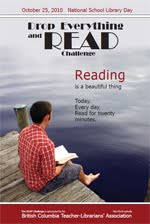
 SDSS celebrated Drop Everything and Read on October 19, 2010. Special thanks to Ms. Crump's English 9 class who allowed me to join them in their silent reading time.
Wednesday, October 20, 2010
DEAR
SDSS celebrated Drop Everything and Read on October 19, 2010. Special thanks to Ms. Crump's English 9 class who allowed me to join them in their silent reading time.
Wednesday, September 22, 2010
The Possibility of Fireflies
 Ellie spends a lot of time alone. Her mother is becoming increasing unhinged since her father left them. Gwen, Ellie's sister, is someone Ellie no longer knows or wants to know. She is waiting for someone to come and rescue her from school and her family. As Ellie grapples the dangers of smoking, arson, drugs, alcohol, risky sex, and an abusive mother, Paul creates an intensive narrative and gripping plot. How will Ellie choose to escape her troubled life? The Possibility of Fireflies will appeal to students in grades 8 and 9.
Tuesday, September 21, 2010
The Boy from the Basement
 Charlie has been confined to the basement since his family moved to town from the lake. One night the back door slams shut and Charlie is locked outside. Charlie is fearful of the outside; he longs for the damp walls of his only home, the basement.
He is taken into care at the local hospital and then into a foster home. As he struggles to adjust to his new life of being 'outside', he learns about Hallowe'en, Thanksgiving and Christmas. His ultimate goal is to one day play soccer outside. But, how can he achieve this; what if father is watching him, what if father finds him? Surely, he will be punished for leaving the basement.
Shaw draws us in to the psychological journey of an abused child as he overcomes nightmares and hallucinations.
While the writing is average and the plot structure somewhat repetitive, there is a thriller aspect to the novel as we wait to see if and when Charlie's father will come back for him.
Monday, September 13, 2010
A Sunday at the Pool in Kigali
Hotel Rwanda, a critically acclaimed film, is loosely based on Courtemanche's Canadian bestseller novel, A Sunday at the Pool in Kigali, as well as the true life experiences of people during the Rwandan genocide.
Friday, September 10, 2010
Wednesday, June 2, 2010
The Road
The Road, Cormac McCarthy (2006)
A father and son travel to the coast in a desperate attempt at survival. They are plagued by marauders, exposure, hunger and their own demonic thoughts. In a post-apocalyptic America are there any good guys? McCarthy's third person narrative is void of much punctuation and rich in allusion of parental love, sacrifice and saving grace. The conversation between the boy and man is limited as the man's memory fades of life before the apocalypse. The boy knows nothing of a world with blue sky, plants, animals and birds. The absence of nature leads to the absence of humanity; save for the love between a father and son. I cried, I rejoiced, and loved this book. This is a true American masterpiece.
Review from Booklist 2006
A man and a boy, father and son, each the others world entire, walk a road in the ashes of the late world. In this stunning departure from his previous work, McCarthy (No Country for Old Men, 2005) envisions a postapocalyptic scenario. Cities have been destroyed, plants and animals have died, and few humans survive. The sun is hidden by ash, and it is winter. With every scrap of food looted, many of the living have turned to cannibalism. The man and the boy plod toward the sea. The man remembers the world before; as his memories die, so, too dies that world. The boy was born after everything changed. The man, dying, has a fierce paternal love and will to survive--yet he saves his last two bullets for himself and his son. Although the holocaust is never explained, this is the kind of grim warning that leads to nightmares. Its spare, precise language is rich with other explorations, too: hope in the face of hopelessness, the ephemeral nature of our existence, the vanishing worlds we all carry within us. McCarthy evokes Beckett, using repetition and negation to crushing effect, showing us by their absence the things we will miss. Hypnotic and haunting, relentlessly dark, this is a novel to read in late-night solitude. Though the focus never leaves the two travelers, they carry our humanity, and we can't help but feel the world hangs in the balance of their hopeless quest. A masterpiece. -- Keir Graff (Reviewed 08-01-2006) (Booklist, vol 102, number 22, p9)
Subscribe to:
Posts (Atom)
